
Meta Ads have become an important way for businesses to reach potential customers online. Whether you are running a small local business, an e-commerce store, a personal brand, or a growing company, Meta’s advertising platforms can help you reach specific audiences and promote your products or services.
But simply creating an advertisement isn’t enough.
A successful Meta Ads campaign requires the right audience, creative content, campaign objective, budget, landing page, and continuous optimization.
In this guide, we’ll explain what Meta Ads are, how they work, different types of Meta advertising campaigns, targeting options, benefits, common mistakes, and how businesses can use Meta Ads for growth.
What Are Meta Ads?
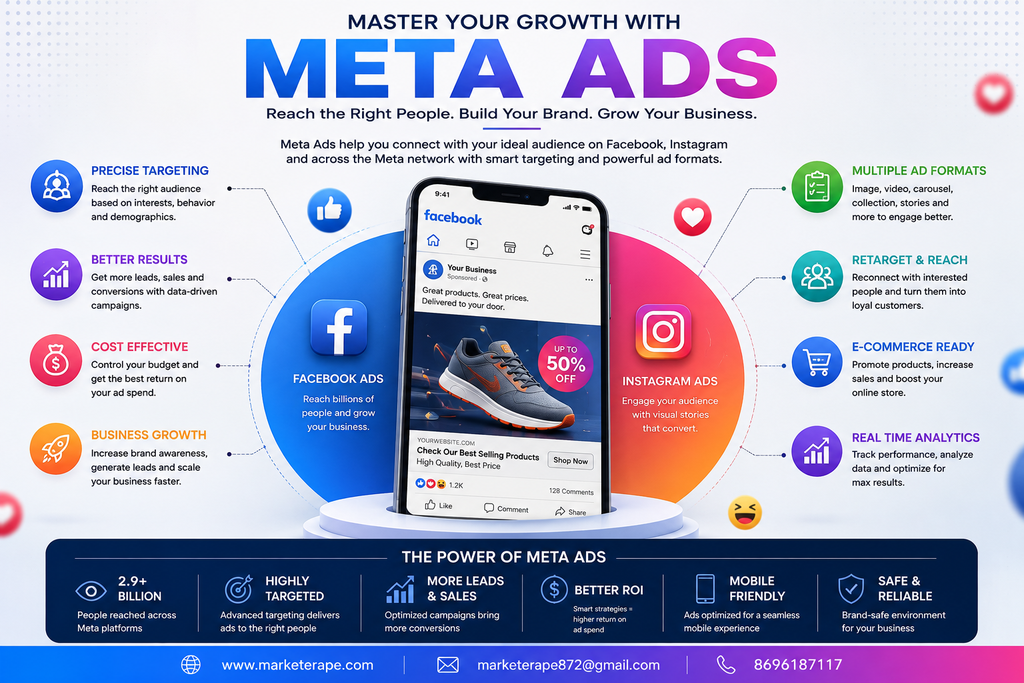
Meta Ads are paid advertising campaigns that businesses can run across platforms owned by Meta, including Facebook and Instagram.
Advertisers can use Meta’s advertising system to show their ads to selected audiences based on factors such as interests, demographics, behaviors, location, and interactions with their business.
Depending on the campaign, ads can be used to:
- Build brand awareness
- Generate leads
- Increase website traffic
- Promote products
- Generate sales
- Increase engagement
- Get messages
- Drive app activity
The biggest advantage is the ability to reach audiences based on specific marketing goals rather than simply showing an advertisement to everyone.
How Do Meta Ads Work?
Meta Ads work through an advertising auction system.
When you create a campaign, you provide information such as your:
- Campaign objective
- Target audience
- Budget
- Ad creative
- Placements
- Schedule
Meta’s system then determines when and where your advertisement can be shown based on several factors.
Your ad competes with other advertisements for available opportunities to reach users.
This means having the biggest budget doesn’t automatically guarantee the best results.
Relevant targeting, strong creative, user experience, and campaign optimization all matter.
Why Are Meta Ads Important for Businesses?
People spend significant amounts of time on social media, making platforms such as Facebook and Instagram valuable places for businesses to connect with potential customers.
A well-planned Meta Ads strategy can help businesses:
Reach the Right Audience
Instead of promoting your business to everyone, you can create campaigns designed around specific audiences.
Generate Leads
Businesses can use lead-generation campaigns to collect potential customer information through forms and other conversion paths.
Increase Website Traffic
Meta Ads can send users to specific landing pages, product pages, service pages, or websites.
Increase Sales
E-commerce businesses can use Meta advertising to promote products and encourage customers to complete purchases.
Build Brand Awareness
Even when users don’t immediately purchase, consistent advertising can help people become familiar with your brand.
Types of Meta Ads Campaigns
Meta provides different campaign objectives and advertising formats depending on what you want to achieve.
1. Awareness Campaigns
Awareness campaigns are designed to help businesses introduce their brand, products, or services to audiences.
These campaigns can be useful for businesses that want to increase brand recognition.
2. Traffic Campaigns
Traffic campaigns are designed to send people to destinations such as:
- Websites
- Landing pages
- Blog posts
- Apps
- Other online destinations
They can be useful when your goal is to increase visits to a specific page.
3. Engagement Campaigns
Engagement campaigns can help businesses encourage interactions with their content.
These may include:
- Likes
- Comments
- Shares
- Video views
- Event responses
4. Lead Generation Campaigns
Meta lead ads can help businesses generate potential customer inquiries.
Instead of requiring users to leave the platform immediately, businesses can use lead forms to collect information.
This can be useful for:
- Digital marketing agencies
- Real estate businesses
- Education companies
- Service businesses
- Consultants
- Local businesses
5. Sales Campaigns
Sales campaigns focus on encouraging valuable actions such as purchases.
For e-commerce businesses, these campaigns can be combined with product catalogs and tracking systems to help reach people who are more likely to convert.
Meta Ads Targeting
One of the strongest features of Meta advertising is audience targeting.
Businesses can create audiences using different types of information and interactions.
Demographic Targeting
Depending on available targeting options, businesses may target audiences based on characteristics such as age, location, and other relevant demographic information.
Interest-Based Targeting
Businesses can reach people who may have interests related to their products or services.
Custom Audiences
Custom audiences can be created from sources such as existing customer information, website activity, or engagement with a business’s content, subject to Meta’s policies and available features.
Lookalike Audiences
Lookalike audiences can help businesses reach people who are similar to an existing audience.
For example, a business may use an existing customer audience as a source to find potentially similar users.
Retargeting
Retargeting allows businesses to reconnect with people who have already interacted with their website, content, products, or brand.
This can be particularly useful because these users may already be familiar with the business.
What Makes a Good Meta Ad?
A successful advertisement isn’t necessarily the one with the most complicated design.
Often, simple and clear communication works better.
A strong Meta ad usually includes:
A Clear Hook
The first few seconds or first line should give users a reason to pay attention.
Strong Visuals
Images and videos should clearly communicate the product, service, or benefit.
Useful Copy
Your ad copy should explain why the user should care.
A Clear CTA
Tell the audience what to do next.
Examples include:
- Learn More
- Contact Us
- Shop Now
- Get Quote
- Sign Up
- Send Message
A Relevant Landing Page
If an advertisement promises something, the landing page should deliver the same message.
Meta Ads vs Organic Social Media
Organic social media and paid advertising serve different purposes.
Organic social media focuses on building an audience and engaging with followers without paying for every impression.
Meta Ads use paid distribution to reach selected audiences based on specific campaign goals.
For many businesses, combining both approaches can be more effective.
Organic content can build trust and community, while paid campaigns can help extend reach and generate targeted actions.
Meta Ads Budget
There isn’t one universal budget that works for every business.
Your advertising budget can depend on:
- Industry
- Competition
- Target audience
- Location
- Campaign objective
- Product price
- Customer lifetime value
- Conversion rate
- Available creative assets
Instead of asking “What is the cheapest Meta Ads budget?”, businesses should consider:
“What budget allows us to collect enough data to make informed optimization decisions?”
Starting with a controlled budget and scaling campaigns based on performance can be a practical approach.
How to Measure Meta Ads Performance
Running ads without measuring results makes optimization difficult.
Some important metrics include:
- Impressions
- Reach
- Click-through rate (CTR)
- Cost per click (CPC)
- Cost per lead (CPL)
- Conversion rate
- Cost per acquisition (CPA)
- Return on ad spend (ROAS)
- Frequency
- Engagement
The most important metrics depend on your campaign objective.
For example, a brand-awareness campaign and an e-commerce sales campaign shouldn’t necessarily be judged using exactly the same metrics.
Common Meta Ads Mistakes
Many businesses make avoidable mistakes when running Facebook and Instagram advertising campaigns.
Targeting Everyone
A very broad audience isn’t always the best audience.
Your targeting should be connected to your actual customer profile.
Using Weak Creative
Even excellent targeting can struggle if the advertisement doesn’t capture attention.
Changing Campaigns Too Frequently
Campaigns need enough time and data to evaluate performance.
Constantly making changes can make it harder to understand what is actually working.
Ignoring the Landing Page
Getting clicks is only one part of the process.
If your landing page is slow, confusing, or irrelevant, those clicks may not turn into customers.
Focusing Only on Likes
Likes and engagement can be useful, but businesses should connect advertising metrics to their actual objectives.
If your goal is lead generation, focus on qualified leads rather than vanity metrics alone.
Meta Ads for Small Businesses
Meta advertising can be particularly useful for small businesses because campaigns can be built around specific locations, audiences, and business goals.
A local business, for example, may want to reach people within a particular service area.
An online business may instead focus on audiences across multiple cities or countries.
The strategy should depend on where your customers are and how they make purchasing decisions.
Meta Ads and E-Commerce
For online stores, Meta Ads can be an important part of the customer acquisition strategy.
Businesses can use advertising to promote:
- Products
- Offers
- New launches
- Collections
- Seasonal campaigns
- Retargeting campaigns
Combining strong product pages, compelling creatives, accurate tracking, and well-structured campaigns can create a stronger advertising funnel.
Meta Ads and SEO: What’s the Difference?
SEO and Meta Ads are not competitors.
They are two different digital marketing channels.
SEO focuses on improving organic visibility in search engines.
Meta Ads focus on paid distribution across Meta platforms.
SEO can help capture people actively searching for information, products, or services.
Meta Ads can help businesses reach audiences based on targeting and advertising signals even when those users aren’t actively searching.
For many businesses, combining SEO + Meta Ads + content marketing + a strong website can create a more complete digital marketing strategy.
The Future of Meta Advertising
Digital advertising continues to evolve.
Artificial intelligence, automation, improved audience modeling, creative optimization, and better measurement are changing how advertising campaigns are managed.
Businesses will increasingly need to focus on:
- Better creative
- Stronger customer experiences
- First-party data
- Conversion tracking
- Useful landing pages
- Audience understanding
- Continuous testing
The brands that understand their customers and adapt their strategies will have a better opportunity to compete.
How Marketer Ape Approaches Meta Ads
At Marketer Ape, we believe Meta Ads should be connected to a business’s larger marketing strategy.
An advertisement shouldn’t simply generate clicks.
It should have a clear purpose.
Our approach can include:
- Audience research
- Campaign planning
- Meta Ads setup
- Creative strategy
- Ad copy
- Audience targeting
- Retargeting
- Campaign optimization
- Performance analysis
- Conversion-focused landing pages
We combine Meta Ads, SEO, social media marketing, website development, WordPress, content marketing, and performance marketing to help businesses build a stronger digital presence.
Final Thoughts
Meta Ads can be a powerful tool for businesses when they are planned and managed correctly.
But successful advertising isn’t about simply spending more money.
It’s about understanding your audience, creating relevant advertisements, choosing the right campaign objective, measuring performance, and continuously improving the strategy.
Whether your goal is lead generation, sales, website traffic, engagement, or brand awareness, a well-planned Meta Ads campaign can become an important part of your digital marketing strategy.
At Marketer Ape, we focus on combining creativity, strategy, technology, and performance to help businesses make better use of digital marketing.
Don’t just run ads. Build campaigns with a purpose.
Frequently Asked Questions About Meta Ads
Meta Ads are paid advertisements that businesses can run across Meta platforms such as Facebook and Instagram.
Facebook Ads are now part of the broader Meta Ads ecosystem. Meta’s advertising platform supports advertising across multiple Meta-owned placements.
There is no fixed price. Costs depend on factors such as audience, competition, location, campaign objective, creative quality, and bidding conditions.
Yes. Small businesses can use Meta Ads to target relevant audiences and promote products or services within controlled budgets.
Neither is universally better. SEO is focused on organic search visibility, while Meta Ads provide paid reach. Many businesses can benefit from using both.
Results can vary significantly depending on the campaign objective, audience, budget, offer, creative, tracking, and conversion process. Campaigns should be evaluated using meaningful performance data rather than a fixed timeline.
Yes. Businesses can use Meta’s lead-generation capabilities to collect inquiries and potential customer information, subject to applicable platform policies and setup.